An Anthology
Indian Territory: The Aftermath
This Was Never Just One Family’s Story
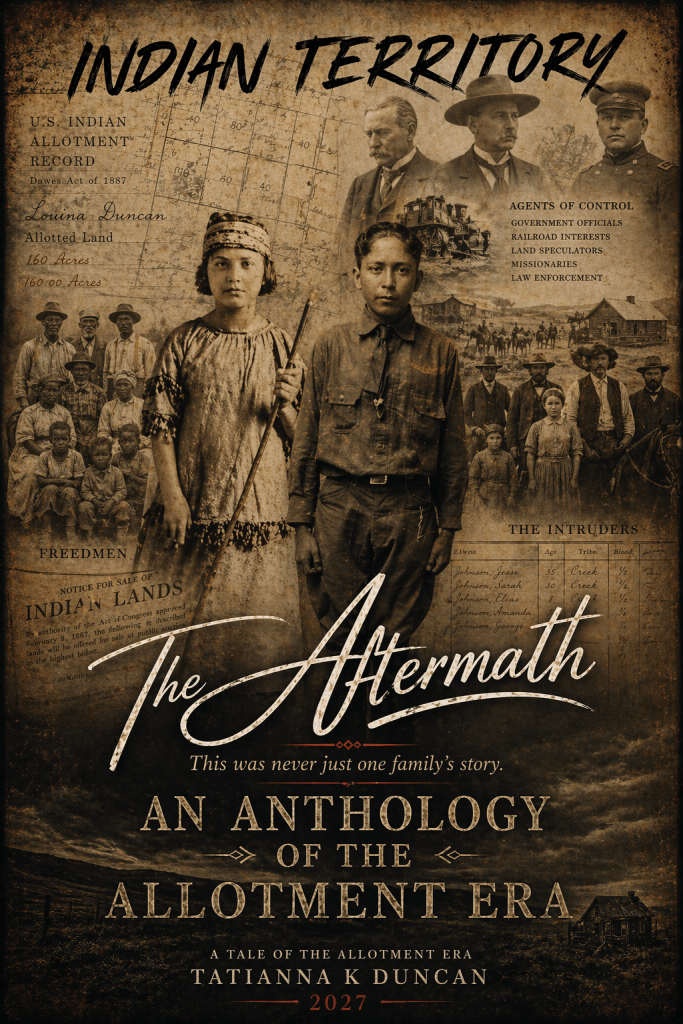
My Native Story, in collaboration with the Lucinda Hickory Research Institute (LHRI), is creating an allotment-era anthology titled The Aftermath.
This anthology will be a collection of stories connected to the Allotment Era and its lasting impact on Native families and communities. We are seeking Native Americans who have a story to tell about their family’s allotted land, the people who received it, and the events that followed.
Individually, these stories tell the history of a single family. Together, they reveal the larger story of the Allotment Era.
To help ensure a broader understanding of this period, we also welcome submissions from descendants of Freedmen, guardians, attorneys, agents, and others whose ancestors participated in or were affected by the systems that shaped the allotment experience.
Please review the submission guidelines below.
LHRI will be offering workshops in the coming months focused on research, writing, and storytelling. These workshops are designed to help contributors uncover, document, and share their family histories.
Questions and comments may be directed to:
I understand my submission is not complete until the $10 submission fee has been paid.
Anthology Submission Guidelines,
As Shared on the Dawes Roll
Eligibility
Submissions must meet the following:
- Contributors may be noncitizens but must be a descendant of a federally recognized tribe of Oklahoma. (Or must write about an ancestor of a federally recognized tribe.)
- Submissions should relate to the Allotment Era (1898–1935)
- Must be from Indian Territory/Oklahoma
Information About the Contributor
- Full Name
- Email Address
- Tribal Citizenship (if applicable)
- Tribal Affiliation (if not enrolled)
- If not Native American, relationship to the story (Freedmen descendant, guardian descendant, researcher, family member, etc.)
Submission Focus
Each submission should center on:
- A specific ancestor, family allotment, or documented experience
- Events, patterns, or outcomes connected to allotment, land, guardianship, probate, or related systems
- The lived family impact of this period, supported by family knowledge and/or documentation
Required Identifying Information of Ancestor
(To be included at the beginning of submission)
Full Name
Tribal Citizenship or Tribal Affiliation
Blood Quantum
Dawes Roll Number (if applicable)
First Language Spoken
Level of English Literacy
Relationship to Contributor
Location of Allotment (Section/Township/Range, County)
Present day location
These details will help us identify patterns that were often used to determine control, competency, and access—and in many cases, they shaped the outcome of the allotment itself.
Foundation of Story to include;
Submissions should include at least one of the following:
- Oral history (clearly identified as such)
- Family records or testimony
- Legal or historical documents (deeds, probate records, etc.)
- Newspaper references or archival material
Length Guidelines
Submission Guidelines
- Maximum length: 5,000 words
- Preferred font: Times New Roman, Garamond, Georgia, or another standard serif font
- Font size: 12-point
- Line spacing: 1.5
- Submit as a Microsoft Word (.doc or .docx) document whenever possible
- Include the title of your submission and your name on the first page
- Pages should be numbered
Non-fiction
Submissions should:
- Be grounded in truth, experience, or documented history
- Avoid fictionalization or dramatization presented as fact
- Reflect the seriousness of the subject matter
Personal voice is encouraged, but the integrity of the story must remain intact.
Deadline
- This is a Call for Submissions. Deadline TBA
Editorial Process
- All submissions will be reviewed
- Editing may be required for clarity and consistency
- Final inclusion is at the discretion of the editor
- We do not expect submissions to meet formal academic standards of footnoted documentation. However, the editors at the Lucinda Hickory Research Institute may request supporting materials during the review process when clarification, additional context, or documentation is needed to help preserve the integrity of the historical record.
- Writers are encouraged to explore how the allotment experience shaped their families across generations. This may include the loss of land, forced boarding school attendance, separation from family, cultural displacement, or the loss of language, traditions, and tribal identity. We welcome stories that reflect not only the hardships endured, but also the ways those experiences continue to affect families today through memory, resilience, survival, and the lasting impact of historical trauma.
- Contributors retain ownership of their original work. By submitting, contributors grant permission for selected works to be published in Indian Territory: The Aftermath.
Contributor Copy & Submission Fee
Contributor Copy
If your submission is selected for publication, you will receive one complimentary hardcover copy of Indian Territory: The Aftermath.
Submission Fee
A non-refundable $10 submission fee is required for each entry. Submission fees help support the administrative, editorial, design, printing, and publication costs associated with the anthology.